
Refurbishing or modernising a test bench is an option increasingly favoured by companies and laboratories. It involves replacing one or more components of a bench, such as the instrumentation or the IT system, which are particularly prone to obsolescence.
The aim is to significantly extend the service life of installations, which among other things makes it possible to amortise the heavy investments required to set them up. An economical alternative, refurbishment is indisputably an eco-responsible approach.
Modernising a bench is also an opportunity to rethink processes and imagine new features for the installation. As shown by the refurbishment that Nerys Group had the opportunity to carry out for the power tool test and validation department of SPIT Paslode.
Selected to refurbish a rotary hammer bench, we ultimately helped turn it into a multi-tool bench. Here is how one refurbishment led to another.
SPIT Paslode, founded in 1951 in Valence (26), offers complete fastening systems suited to all construction applications. Its offering is built around three product ranges: nailing and stapling, chemical and mechanical anchors, and power tools. They are all tested in dedicated units. Power tools are put through their paces in the power tool test and validation department headed by Ludovic Tournier, innovation and development manager.
"Our rotary hammer bench is a very old piece of equipment whose mechanical base is still extremely robust. Our need was to replace the control software and the ageing instrumentation," explains Ludovic Tournier.
The installation holds a rotary hammer that moves horizontally and vertically above a concrete slab thanks to a 2-axis Cartesian robot. The slab can also move up and down and rotate on itself, which allows both of its faces to be fully used. A pneumatic cylinder drills the slab positioned horizontally or vertically. The bench runs continuously 24 hours a day with drilling cycles of several thousand holes. The aim is to push the tool to its limits. Its performance is compared with other references in the range, in particular by measuring its drilling time with drill bits of different sizes.
"We consulted Nerys and two other companies for the refurbishment of the bench. What clinched the decision was clearly the Vasco software. With its native functions, it was an opportunity to save hours and hours of development, where one of the companies proposed starting from scratch!" reveals Ludovic Tournier.
He adds: "With our old control software developed in LabWindows, we managed to retrieve measurements via a CSV file that we then reprocessed, but it was quite complicated. The format was fixed and nobody knew how to work in that environment any more, as the most experienced operator on the bench had retired.
We were won over by the accessibility and modularity of Vasco. Indicators can be displayed live. The interface is user-friendly and ergonomic. Commands can easily be changed without touching the code. A real plus for a team of mechanical engineers like us," he stresses.
"I must also admit that I was pleasantly surprised by the technical level of the Nerys staff. One of the difficulties of our project was that we had specified very little in the consultation. Frédéric and Amaury immediately understood how the system worked and showed great flexibility. We did the retrofit on the fly!"
The refurbishment was not without its adventures. "There were difficulties during commissioning. The variable speed drives failed; we handled their replacement, as well as that of the motor, with the manufacturer. We also reworked the safety aspects of the bench," stresses Frédéric Bernard, the main architect of this refurbishment.
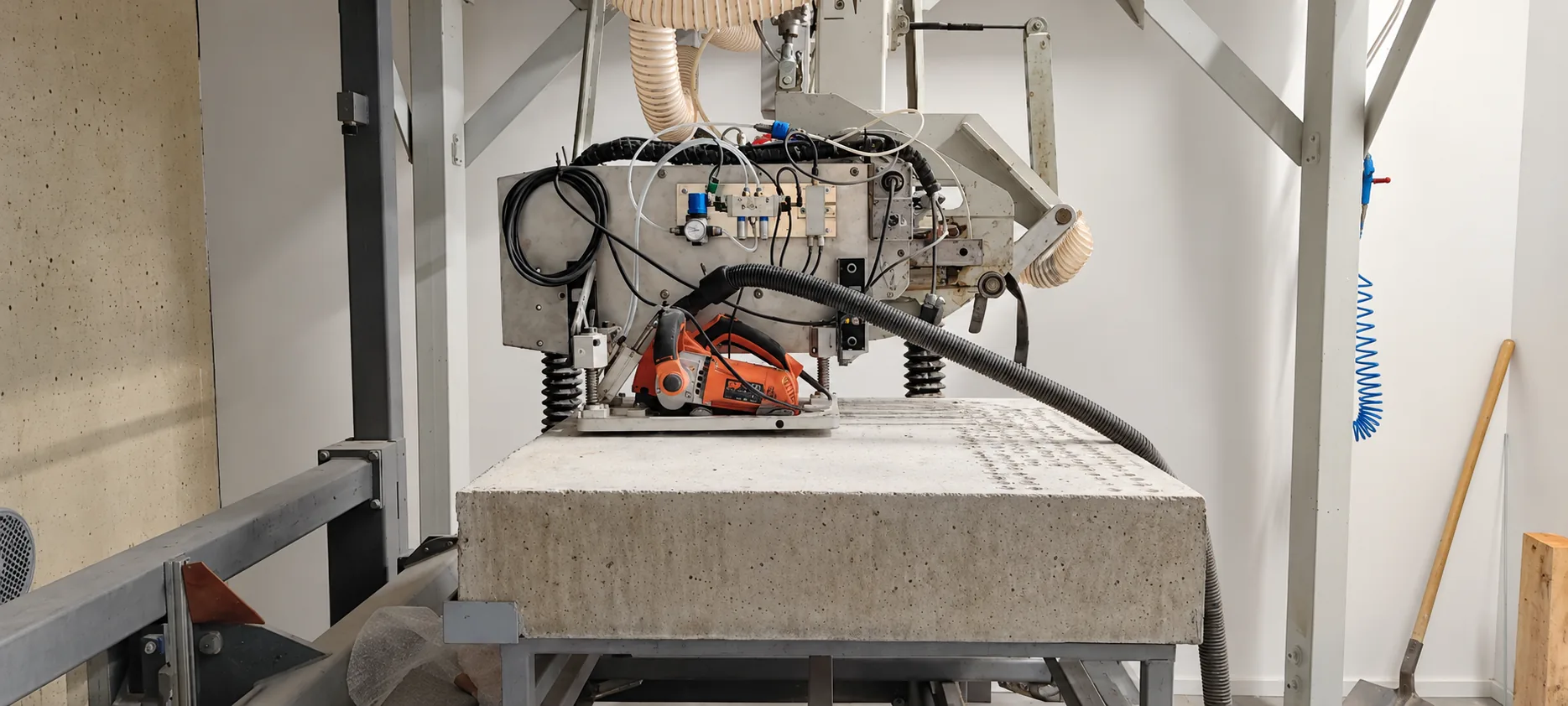
The bench was used for several months without any problems. A reliability that led Ludovic Tournier's team to imagine a new "destiny" for this rotary hammer bench. What if it were used to test concrete wall chasers?
Wall chasers cut grooves in walls to run cables or embed pipes. The new machine is manufactured in SPIT Paslode's new premises in Valence. For this bench, the aim is to evaluate the tool's performance by simulating a constant contact force, and also to do without the operator who usually monitors the tests. "We of course made a few modifications. In particular, we had a steel mechanical support made to fit the wall chaser. This evolution made sense because there was a large mechanical base in common with the rotary hammer bench," concludes Frédéric Bernard.
The collaboration between SPIT Paslode and Nerys Group continues
Building on this first successful collaboration, Ludovic Tournier's department entrusted the Nerys team with the refurbishment of a screwdriving bench. It is a braking system that simulates a screw going into wood or plasterboard screws. With the features offered by Vasco, we moved away from an on/off test scheme. We can simulate a varying torque. We can reproduce the behaviour of the screw more finely, in particular when it comes into contact with the surface of the material and its progress slows down.
The bench is old. It runs on a Siemens PLC that is no longer maintained. "We had to keep an eye on it, because it could stop at any moment and did not record data. Thanks to the refurbishment, we can now measure and record temperatures, current, rotation speed, voltages, power… Nerys also redid all the electrical engineering," explains Ludovic Tournier.
Nerys Group thanks Ludovic TOURNIER for his testimonial.
Ludovic Tournier - Innovation and development manager - SPIT-PASLODE Electrical power tools


