
On 16 and 17 October, Nerys Group is at the Mesures Solutions Expo trade show at the Lyon Convention Centre. You can find our team on stand B41.
We also had the pleasure of giving, on the first day of the event, a technical talk on the theme "Measurement system performance: is it possible to transmit signals without 'noise'?"
Many thanks to the many participants, to Réseau Mesure, the show's organiser, for this opportunity, and to our pair of experts, Amaury Laurent and Frédéric Bernard, for their brilliant, lively presentation.
On a machine, in a laboratory or in a factory, taking a quality measurement is a challenge. Our two experts, with years of professional experience and backgrounds in instrumentation and applied physics, tell the wild story of an analogue signal in a hostile world of noise and interference.
Objectives of this presentation
Understand and deal with noise in the various elements of the measurement system.
- Is it possible to transmit signals without noise?
- Performance depends on your application: performance = subjective
- Understand what is at stake to avoid the pitfalls
Our presentation is not a course – it is our vision – our expertise.
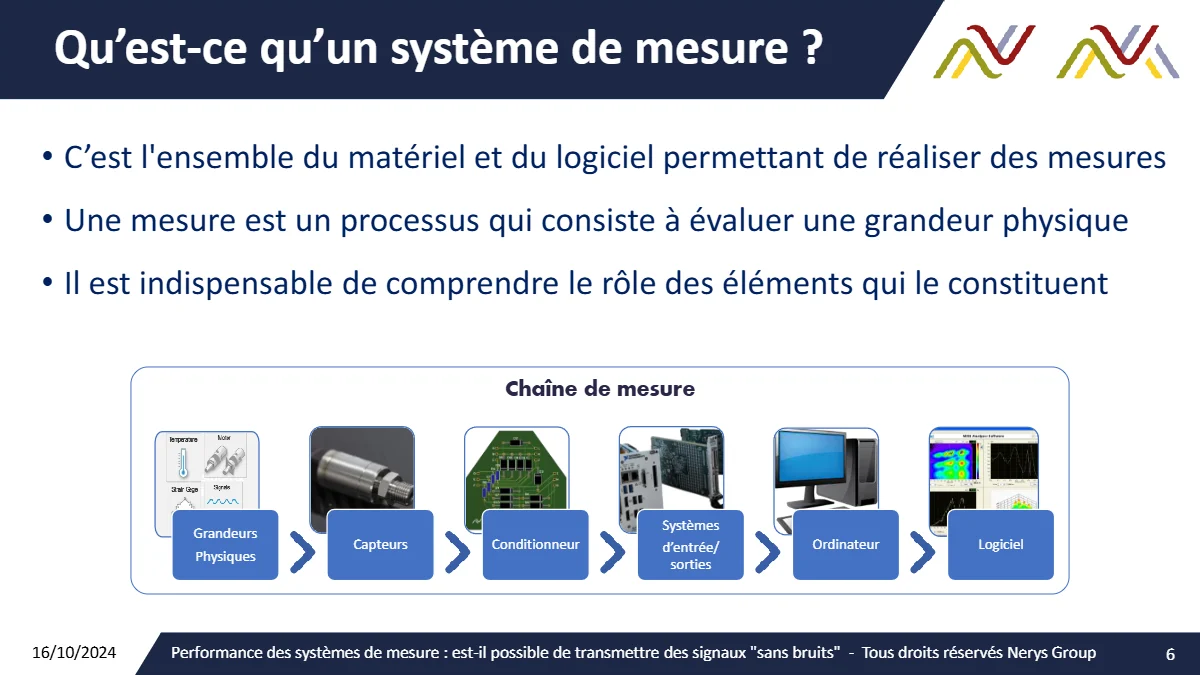
What is a measurement system?
- It is all the hardware and software used to take measurements
- A measurement is a process that consists in evaluating a physical quantity
- It is essential to understand the role of the elements that make it up
The measurement chain: physical quantities, sensors, signal conditioner, input/output systems (acquisition and output), computer, software.
From theory to practice
Just connect the elements and it measures. Sometimes in the laboratory… but rarely in real life. Why? Because there is noise on the measurement…
Measurement noise: definition
Noise is the set of parasitic signals superimposed on a piece of information.
- In our case, they are induced by sources external or internal to the measurement system
- Various origins:
- Mechanical: vibrations, expansion…
- Electrical: switch-mode power supply, poor-quality earth…
- Environment: temperature, radiation…
- Wiring: interference between signals
- The signal-to-noise ratio is generally quantified in dB
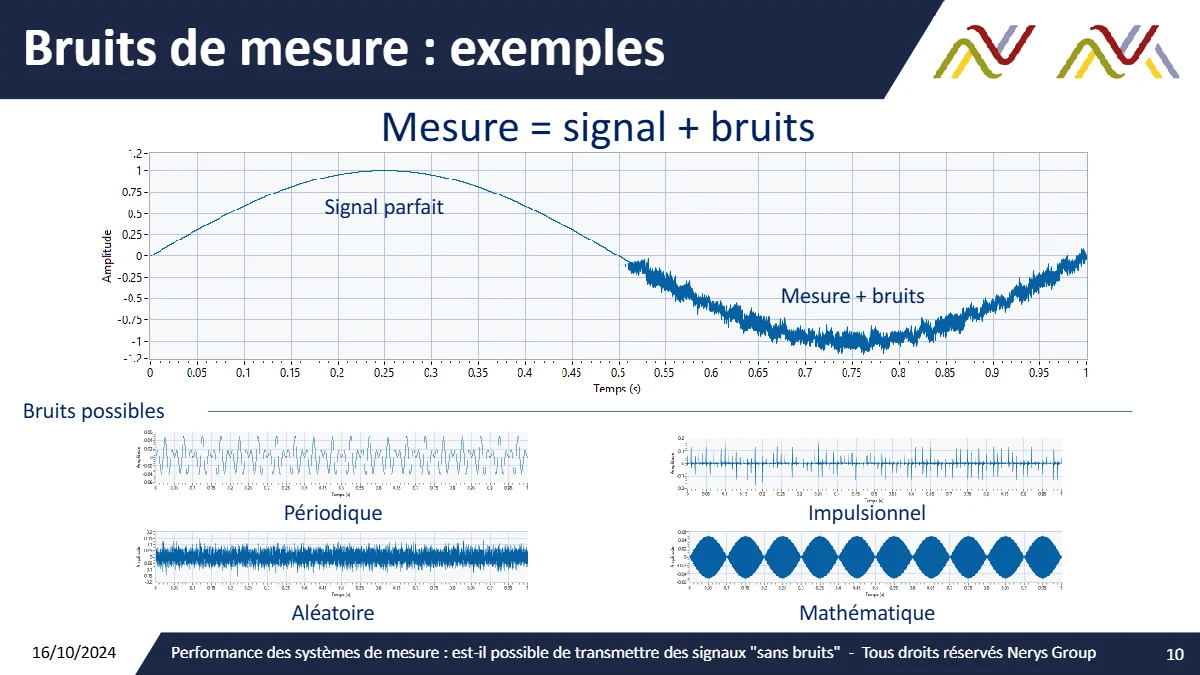
Measurement = signal + noise. Possible types of noise: periodic, impulsive, random, mathematical.
The story begins with the sensor…
It is the origin of the measurement.
- Transducer: converts a physical signal into an electrical signal
- The sensor is where "the noise" begins
- A few examples of characteristics for selecting a sensor: accuracy, range – full scale…
… to reach digitisation…
- Digitisation converts the electrical signal into usable information
- Many criteria must be taken into account
- Compromises often have to be made: signal types, number of input/output channels, amplitude, sampling rate, resolution, bandwidth, price…
Be careful not to introduce new noise.
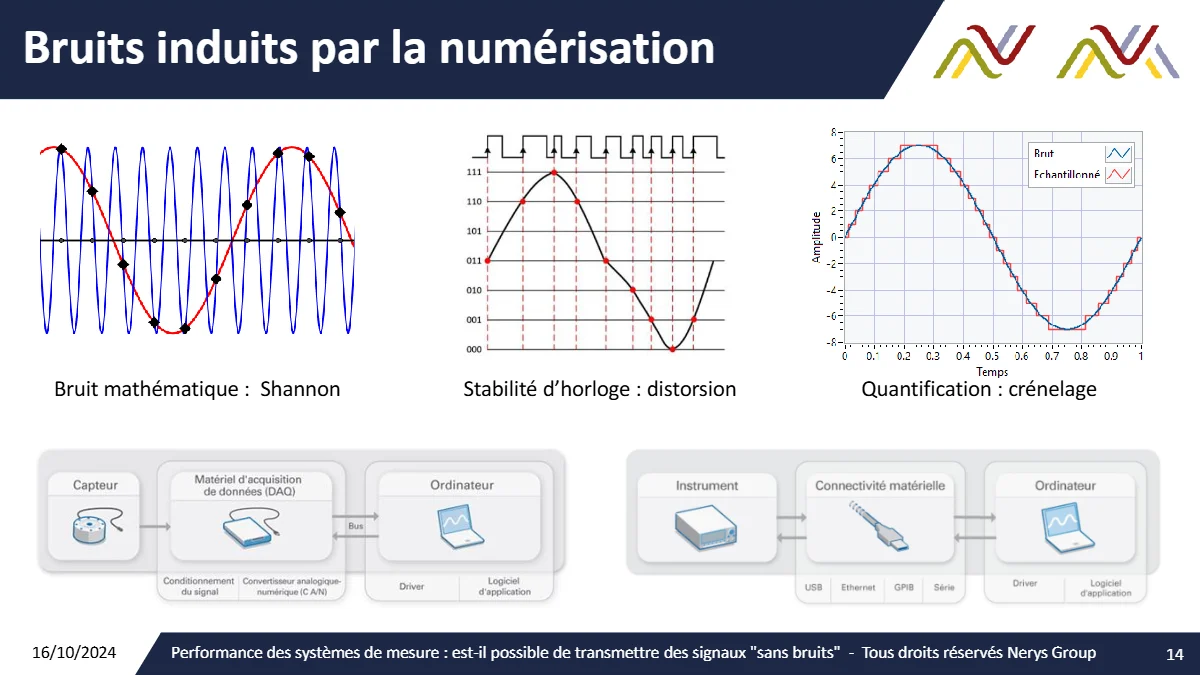
Noise induced by digitisation: mathematical noise (Shannon), clock stability (distortion), quantisation (aliasing).
… via the signal conditioner…
The electrical quantity supplied by the sensor may be a voltage, a resistance, a frequency or any other electrical attribute.
- Condition the signal: adapt the type of electrical quantity
- Amplify: adapt the dynamic range of the signal
- Isolate: adapt the electrical reference of the signal
The sensor is rarely compatible with the digitisation system. It needs to be adapted.
In addition to adapting the sensor, the conditioner can strengthen the signal to reduce the influence of noise:
- Amplify because too weak (100 µV → 10 V)
- Filter because noisy (50 Hz notch filter)
- Galvanically isolate (reference adaptation)
The conditioner must be as close as possible to the sensor to avoid propagating noise.
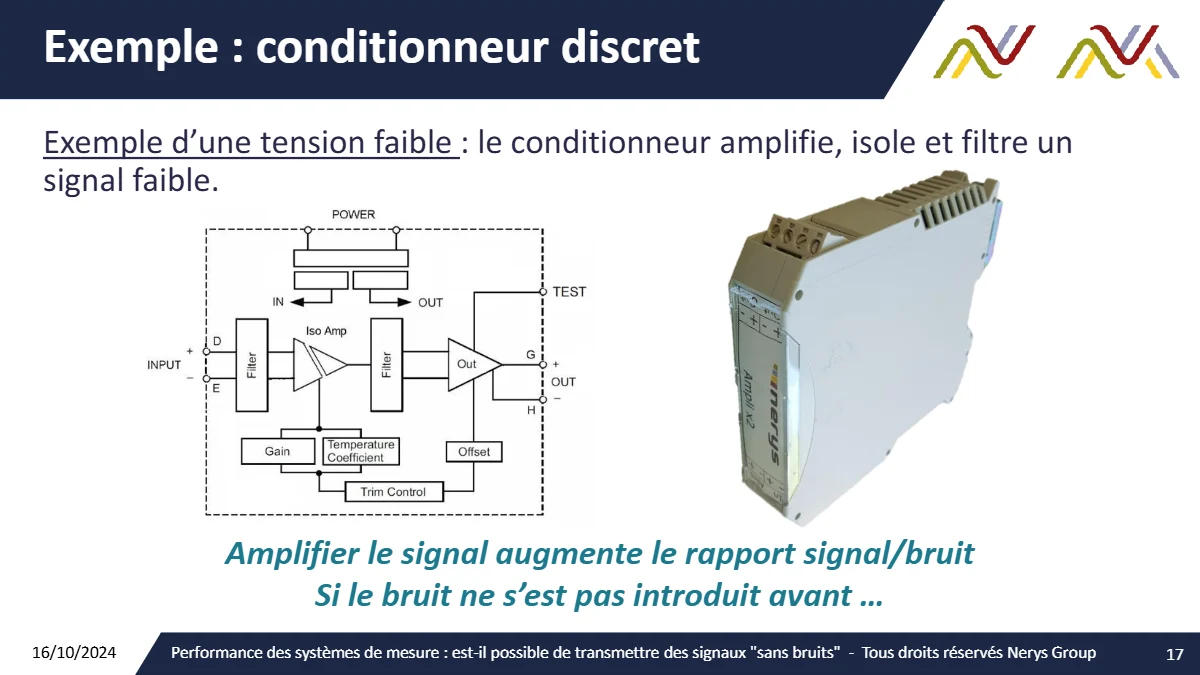
Example: discrete conditioner. Example of a low voltage: the conditioner amplifies, isolates and filters a weak signal. Amplifying the signal increases the signal-to-noise ratio, provided the noise did not get in beforehand…
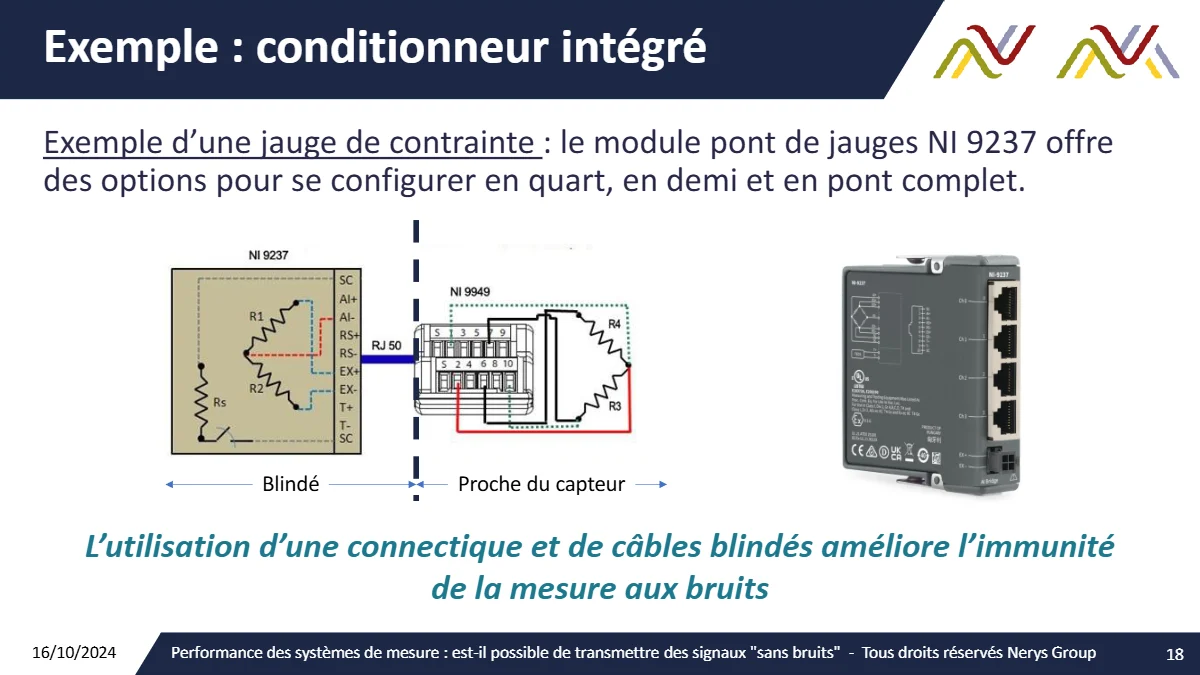
Example: integrated conditioner. Example of a strain gauge: the NI 9237 bridge module offers options for quarter-, half- and full-bridge configuration. Using shielded connectors and cables improves the measurement's immunity to noise.
… from cable to cable…
The influence of wiring is too often forgotten! Good practices are essential. Not following them can lead you to measure more noise than signal.
A few reminders
- Some signals are more sensitive to noise: a voltage is more easily disturbed than a current or a frequency
- A measurement is often a voltage
- Voltage is the difference in electrical potential between two points
- Ground is the reference for electrical potentials
- Ground is often referenced to 0 V by being connected to earth
Good practices…
- Separate high-power and low-level circuits
- Respect the referencing modes (referenced, non-referenced, differential, pseudo-differential)
- Avoid circulating currents:
- Avoid ground loops
- Ensure good-quality equipotential bonding
- Balance impedances
- Avoid floating signals
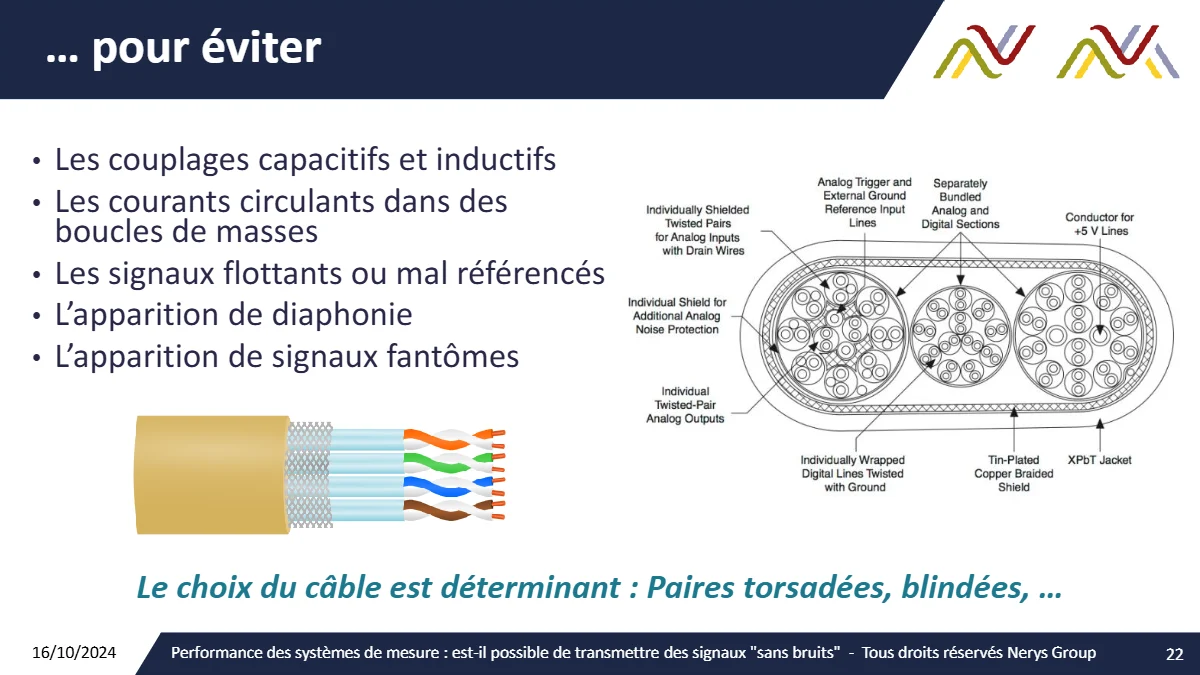
… to avoid
- Capacitive and inductive coupling
- Currents flowing in ground loops
- Floating or poorly referenced signals
- Crosstalk
- Ghost signals
The choice of cable is decisive: twisted pairs, shielded…
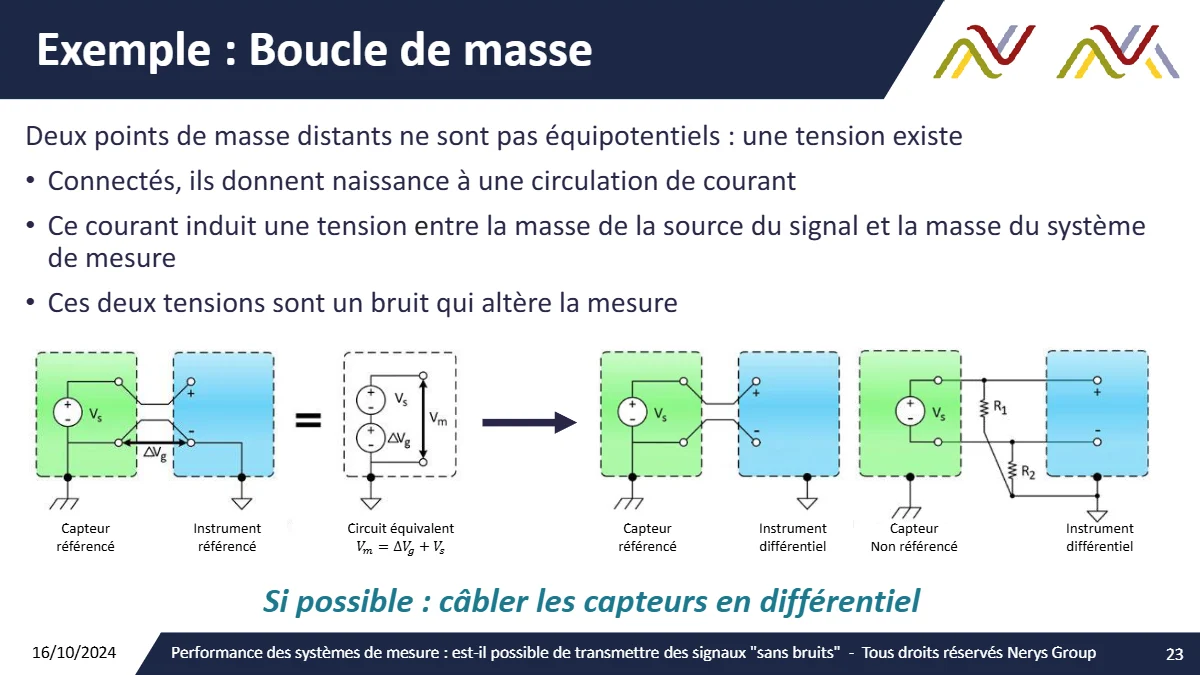
Example: ground loop. Two distant ground points are not equipotential: a voltage exists.
- When connected, they give rise to a circulating current
- This current induces a voltage between the ground of the signal source and the ground of the measurement system
- These two voltages are noise that corrupts the measurement
If possible: wire the sensors in differential mode.
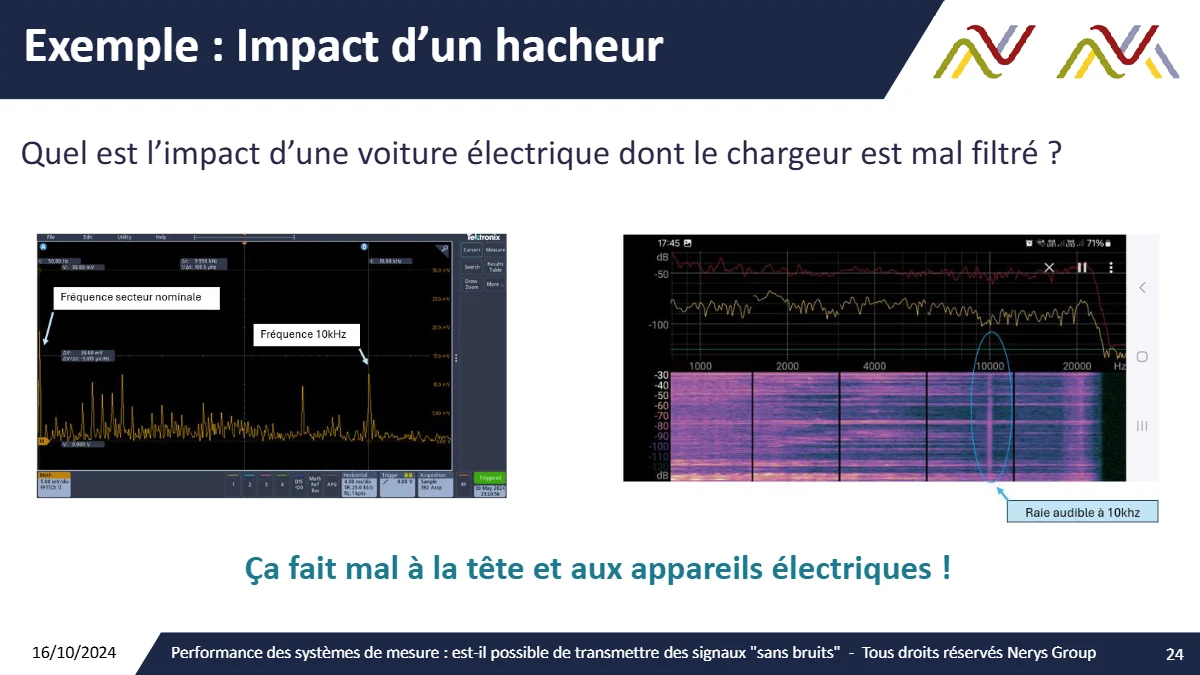
Example: impact of a chopper. What is the impact of an electric car whose charger is poorly filtered? It hurts your head and your electrical equipment!
Beware of computers. The computer is currently the preferred platform for instrumentation systems. Acquisition hardware often shares the same reference as its computer.
- A desktop computer is referenced to earth via the wall socket: the acquisition system may be poorly referenced.
- A laptop is unreferenced on battery and rarely referenced by its charger: the acquisition system may be floating. Adding a reference to the system must then be considered by connecting its 0 V to ground.
Let us not forget that for a quality measurement it is imperative to have a single point of contact with ground.
… and ends up in the software
Too late!
- The noise has taken hold
- It has been amplified
- It has multiplied
- It has distorted the signal
It is still possible to attenuate it using the software (filtering) or to quantify it (FFT…).
A few points to watch
- Resolution must be consistent with accuracy
- Beware of non-linear calculations (RMS, log…)
- Data encoding can degrade the signal
- Rounding or truncation may be lurking in the algorithms
- Accumulation of residuals is possible (recursive filters)
- Mathematical phenomena can modify the signal (convolution, windowing…)
Conclusions
Transmitting signals without noise in a high-performance measurement system:
- There is no measurement without noise; the aim is to minimise it
- The further upstream noise enters the measurement chain, the greater its impact
- To transmit a signal well, it is important to know it
- Dealing with noise as early as possible prevents it from propagating
- Respecting the electrical reference is a fundamental point
Bibliography
- NI, Measurement fundamentals
- LabVIEW Programmation et applications (Dunod – ISBN: 978-2-10-078283-3, in French)
Download the full presentation as a PDF (in French)


