
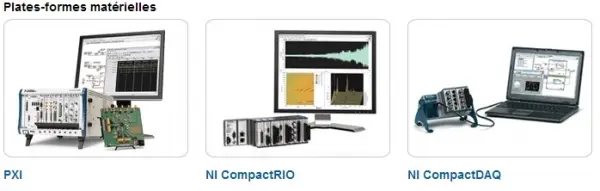
NERYS regularly uses National Instruments hardware on the test benches and data acquisition systems we design or refurbish...
That is why we decided to write a short comparison, frankly and with the relatively neutral eye of an integrator, but also of a National Instruments partner.
First of all, I should point out that the observations in this article will be obsolete within days of its publication... and that it does not deal with special cases but with a certain generality.
The idea is to help you choose the hardware best suited to your needs, but nothing beats a discussion around a table and personalised advice from our engineers.
PC boards, CompactDAQ chassis, CompactRIO or PXI-RT: what to do, what to choose?
Let's take a fairly typical case where we have several channels to measure, with temperatures, strain gauge bridges, Pt-100s, currents, voltages (not just 0-10 V!) and a bit of digital communication: OPC, CAN or a bit of LIN. With, of course, a significant number of channels, about 50 including 24 V digital I/O. For acquisition rates, I would say 10 Hz to 10 kHz per channel with 16-bit resolution on average.
First question to ask: do I need real-time (RT)?
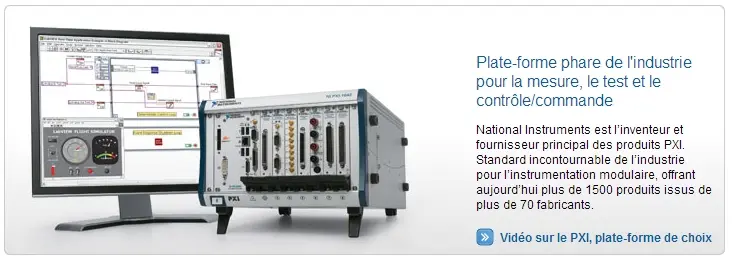
If so, PC boards1 or the CompactDAQ platform are out. One could write a whole article on "do I need real-time?", but we will assume you know whether you need RT or not.
First case: you don't need real-time
Times have changed and nowadays very robust applications can be built on Windows PCs (and I am not afraid to write it): multi-core processors, combined with a good old watchdog, allow 24/7 operation with sufficient safety conditions for many applications. The advantage is that you save on RIO or RT hardware, which costs a bit more than an equivalent Windows configuration, not to mention the extra cost of LabVIEW RT or LabVIEW FPGA licences.
Note, however, the integrated CompactRIO chassis, which are very competitive and almost the same price as Ethernet solutions (see the NI cDAQ-9188 at €1,399 and the NI cRIO-9073 at €1,599)*.
So between PC boards and CompactDAQ, I would say CompactDAQ without hesitation. All the more so as in our case we have signal conditioning to add before reaching the boards. Most PC acquisition boards are ±10 V for analogue channels and 0-5 V for digital channels (TTL or digital I/O, depending on your habits). With a few exceptions, I would say PC boards are somewhat solutions of another age.
Our preference between USB CompactDAQ and Ethernet CompactDAQ: Ethernet, without hesitation! Especially for industrial applications it is a real plus: no risk of unexpected USB disconnections. No need for a repeater to go up to 100 m! A bit more expensive but so much better! (See the NI cDAQ-9188 at €1,399 and the NI cDAQ-9178 at €1,099.)
I also advise you to read the article on the overall performance of a CompactDAQ: http://www.ni.com/white-paper/9939/en/
You will learn, for example, that you cannot have more than 3 different tasks on the same chassis.
Second case: you need real-time
If you need RT, you can opt for the CompactRIO or PXI-RT platforms... but which is the best technical/price solution?
We had got into the habit of using PXI hardware and its signal conditioning system in SCXI chassis, but it is true that for a few years now at National Instruments the SCXI platforms have been losing ground since the release of CompactDAQ and CompactRIO hardware. When comparing the acquisition + conditioning cost between PXI-SCXI and CompactRIO (or CompactDAQ), the advantage goes rather to CompactRIO. As well as saving space in the cabinet, conditioning and acquisition are integrated in each module and potentially per channel. With SCXI, most of the time we were in multiplexed mode, and per-channel conditioning was quite expensive.
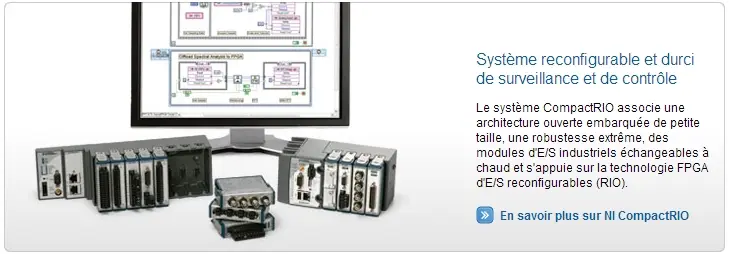
Beware: this does not include the cost of RT and FPGA licences nor the time to spend if you have a lot of code to run on the RIO. Tools exist to simulate and see whether your code will fit in a given CompactRIO chassis. Our practical advice: it is better to size the processor properly than to spend several days optimising the code so that it fits on a "small processor"... Don't forget that an engineer day costs €400 to €600 or more.
Another telling sign: no new SCXI board has appeared recently. On the other side, CompactDAQ and CompactRIO keep bringing new things: new chassis, new modules, increasingly impressive performance in so little space (see the NI 9220 with 16 simultaneously sampled analogue inputs at 100 kS/s, or the NI 9381 multifunction I/O module, which is worth a look). There are also more and more third-party modules for GSM, GPS or other digital bus interfaces. So it is really rare not to find what you need in a CompactRIO/CompactDAQ configuration.
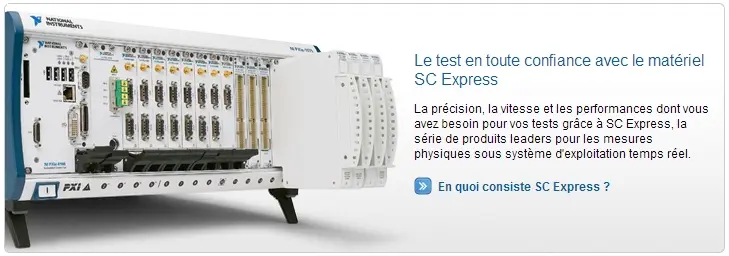
Still worth watching: the arrival of PXI SC Express boards http://sine.ni.com/nips/cds/view/p/lang/en/nid/208286
The offering is not yet as attractive as on CompactRIO or CompactDAQ, but knowing National Instruments it should grow.
Part of the site is dedicated to them, www.ni.com/scexpress; it is undoubtedly the successor to SCXI (they even look like the same connectors...). For now there are Pt-100, TC, strain gauge bridge and microphone modules, which is already quite good.
Another interesting alternative to study is the use of third-party conditioning hardware with a PXI-RT. This allows boards with many channels (such as the PXI-6225 or 6255) to be used, with specific modules to condition each channel. Beware, this exercise is not always advantageous in price: you really need a lot of channels and a need for per-channel conditioning and isolation. And above all, don't forget the extra wiring cost and the configuration, which is not necessarily directly provided from the PC. So compare case by case.
Back to our question: RIO or RT? If you are not strictly obliged to use CompactRIO (determinism), then here too the main thing is to take into account the software side and the ease of configuration. The RT version has the advantage of being more flexible and more easily reconfigurable than the RIO version, although the latest version of NI-RIO simplifies the task a little more (I am talking here about the configuration of inputs/outputs and not about the reconfigurable aspect of the FPGAs found on RIO hardware in particular).
Here too I would identify two deliberately black-and-white cases; yours will probably be somewhere in between:
Case 1: I never reconfigure my system
In that case a CompactRIO version is quite attractive
Case 2: I change configuration several times a day
The RT version would probably be more relevant, avoiding having to recreate the channels in LabVIEW FPGA
But this does not apply to all applications: some test benches have almost fixed channel configurations, while others change channel configurations with every test.
Another point that is not negligible in some applications: CompactRIO has no fan, it has much wider operating temperature ranges than PXI, and makes do with natural convection.
Also beware of the CAN or LIN bus aspect on CompactRIO: integration is less easy than on PC or PXI-RT. The new XNET drivers simplify the task a lot, but under RIO and with LabVIEW FPGA... they are not supported; you will have to develop the low-level layers yourself and roll up your sleeves. But nothing insurmountable! Especially as some experienced partners can support you (for example NERYS on +33 (0)4 42 24 52 00).
The new sbRIO boards: a good deal?
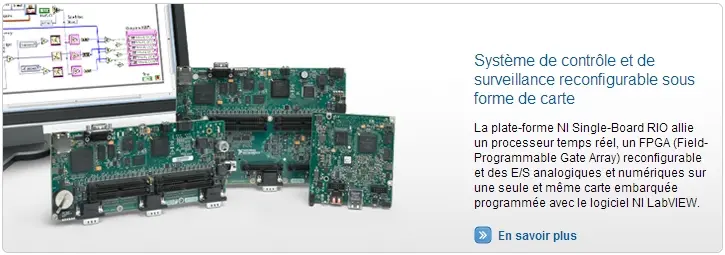
First of all, you should know that sbRIOs are only relevant for projects with systems in quantity, or projects where space is a real problem. Moreover, the boards are not "packaged", so a small integration study will be needed.
With the old sbRIO boards such as the sbRIO-9612, integration was fairly limited to high-volume projects on non-embedded subjects, or to subjects where size and power consumption were not paramount. On the other hand, it must be admitted that with the new sbRIO-9626 and sbRIO-9623 boards, we really have an interesting product for embedded system integration. A real alternative to PC/104 boards and Linux. In terms of cost it is also very competitive; only the power consumption perhaps remains a little high compared with some PC/104 boards or boards dedicated to embedded systems.
It must be said that this niche has literally exploded in recent years and the offering is very wide:
- PC/104
- Freescale
- ARM
- Texas Instruments
- etc.
And we have not even covered all the solutions.
So why NI? Why sbRIO? Very good question. Once the performance/price comparison is set aside, we can then address the software, integration, openness, etc. The sbRIO is a very good product for those who, like us, have a good command of LabVIEW FPGA and National Instruments hardware; there is fairly good continuity when moving from CompactRIO to sbRIO. Better, I would say, than moving from CompactRIO to LabVIEW ARM... because not long ago, if the sbRIO 9612-type platform was not suitable, you had to switch to LabVIEW ARM technology with ARM kits. And very quickly you were forced to complete the LabVIEW ARM developments with C and an associated compiler. So you moved away from graphical programming and the all-NI solution.
On the other hand, for those with a good command of Linux, embedded systems, Keil compilers and the like, it is true that the sbRIO solution might appear proprietary or not open enough.
So for us, with technically equivalent hardware, only the development time, and therefore the skills and habits of the development teams, could justify using one platform rather than the other.
It also depends on the quantity of systems to be produced: if the goal is mass production of consumer devices, this is absolutely not the platform to favour. On the other hand, for smaller series of acquisition systems or control and regulation systems, it can do the job very well and save design costs as well as the manufacture of the first production units. In addition, lead times are those of off-the-shelf hardware (1 to 2 weeks).
All this advice is valid only if the sbRIO performance is suitable (400 MHz processor, 512 MB non-volatile memory and 256 MB DRAM, which is already quite good), and there we really advise validating that the whole application can run on the FPGA. Because code optimisation on FPGA can take a lot of time, and of course beware of false economies such as: I saved €200 per board! Oops, I lost 10 days optimising my code... for 3 boards in total... not very profitable...
In conclusion, the sbRIO-9612 is worth watching closely, especially as the range keeps growing, so stay tuned on http://sine.ni.com/nips/cds/view/p/lang/en/nid/205865
For students, I strongly recommend getting your hands on the new myRIO learning platform http://www.ni.com/myrio/what-is/f/
The stand-alone CompactDAQ and the new CompactRIO chassis
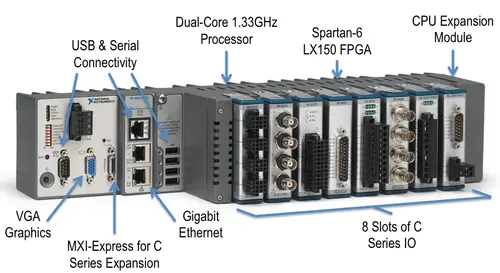
This new platform is very powerful; for now it is high-end and therefore a bit expensive (expect around €5,800 for a cDAQ-9139 under Windows).
Unless you compare it with a high-end PXI, where it becomes competitive (expect €4,970 for a PXI-8135RT plus €870 for the smallest PXIe-1071 chassis).
This platform is ultra-compact: you get a Core i7 PC plus a data acquisition system in less than 5 dm³.
But we can safely bet on a profusion of new products to soon have equivalent platforms at more attractive prices; NI will no doubt expand its range, as this product will undoubtedly become a basic platform for National Instruments.
Did you say Linux?
The latest novelty (September 2013), the NI cRIO-9068 chassis, lets you use the new NI Linux Real-Time operating system. This is a bit too recent for us to have tested it, but it looks very interesting. For now, read the technical note on NI Linux Real-Time: http://www.ni.com/white-paper/14626/en — to be seen, but I think for the time being it will remain a matter for specialists with good C++ and Linux knowledge.
Conclusion
Well, after this journey around NI solutions, we have to conclude. As a reminder, our need was as follows: several channels to measure, with temperatures, strain gauge bridges, Pt-100s, currents, voltages (not just 0-10 V!) and a bit of digital communication: OPC, CAN or a bit of LIN. With, of course, a significant number of channels, about 50 including 24 V digital I/O. For acquisition rates, I would say 10 Hz to 10 kHz per channel with 16-bit resolution on average.
We arrived at the following technical ranking and price ranking (assuming RT is not strictly necessary):
Technical ranking
Number 1: Stand-alone CompactDAQ
Number 2: PXI
Number 3: CompactDAQ
Price ranking
Number 1: CompactDAQ (Ethernet or USB)
Number 2: PCI / PCI Express boards
Number 3: PXI
In any case, do not hesitate to call on NERYS, your specialist in data acquisition software and test bench design and refurbishment.
See you soon!
1 : It is nevertheless possible to run boards in a standard PC under RT, see the article Converting a Desktop PC to a LabVIEW Real-Time Target
NB: all the prices above were collected in early 2013 and will not be updated, so the conclusions of this article may well be contradicted...


