
"Projects like this one, you do one, maybe two in a career!" stresses Amaury Laurent, embedded systems and R&D project manager at Nerys. This exceptional adventure, in which he is so proud to have taken part, is the Tyrex-2 project, named after a machine unique in the world, designed and used at the Institut Laue-Langevin (ILL) in Grenoble. Tyrex-2 produces polarised helium-3, a gas intended to increase the sharpness of the neutron beams used to study the electromagnetic properties of matter, in major experiments in fundamental research as well as in R&D. The standard Vasco software, developed by Nerys to control test installations, was chosen by the ILL to control Tyrex-2. One year after the machine was commissioned, the software, which runs continuously 24 hours a day with nearly 2,700 lines of scenarios, has demonstrated its reliability and its ability to control a highly complex special machine.
The ILL, one of the most intense neutron sources in the world
Contributing to the Tyrex-2 project means adding a modest stone to the edifice of world research that the ILL represents. Created in 1967 to seal Franco-German friendship and cooperation in research, the ILL provides scientists from all over the world with neutron beams generated by nuclear reactions.
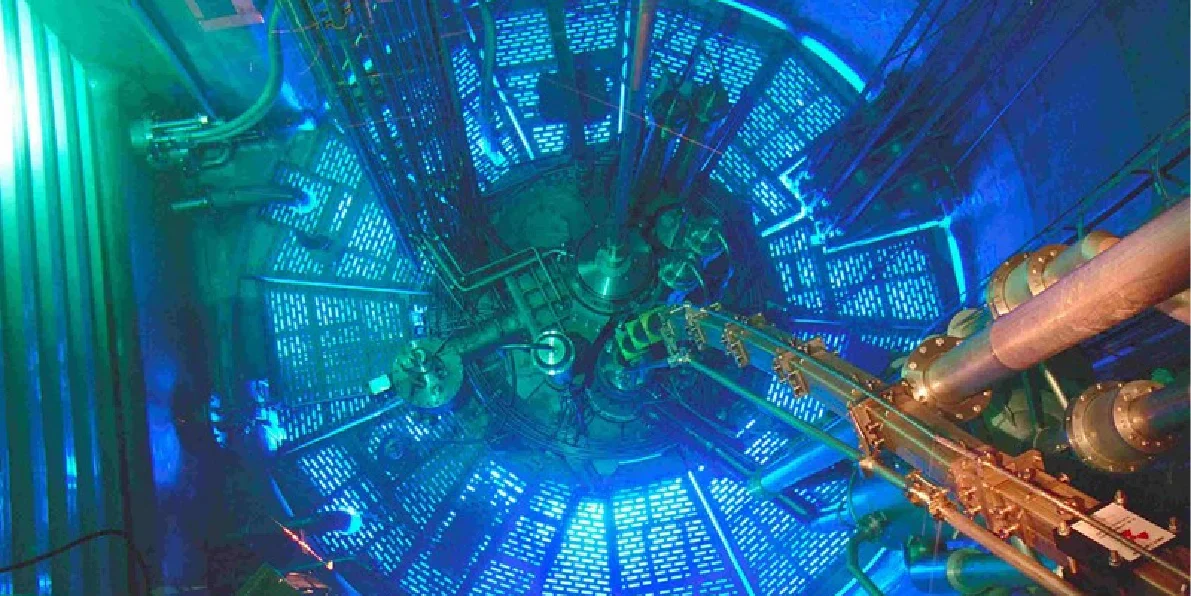
View of the ILL reactor, blue light produced by the Cherenkov effect.
Why produce neutrons? As electrically neutral components of atoms, neutrons make it possible to see the properties of matter with very fine resolution, particularly in metals.
Polarised helium-3 enhances this ability. Polarised by the gas, neutrons make it possible to measure magnetic properties precisely.
Every year, around 1,400 researchers from more than 40 countries come to the ILL to carry out some 1,000 experiments, selected by a committee of experts. These experiments advance fundamental research in fields as varied as biology, chemistry, nuclear physics and materials science. The ILL also works closely with the R&D departments of many industrial companies.
Tyrex-2: an installation for polarising helium-3
Some experiments carried out at the ILL require polarised helium-3. The neutron optics department is in charge of producing it. David Jullien has worked there for more than 20 years. "There are very few traces of helium-3 in its natural state on Earth. Existing stocks come from nuclear industry waste and the decomposition of warheads. This gas is present in significant quantities in the lunar atmosphere," he explains.
To develop the use of polarised helium-3 for neutron experiments, the ILL set up a dedicated team and in 2000 designed a machine, named Tyrex, to polarise the gas and package it in experimental cells. The installation also recovers the polarised helium-3 used in experiments and purifies it before reuse.
"Commissioning Tyrex was strategic. It limited helium-3 losses and allowed the ILL to recycle and polarise an average of 200 litres of gas per year," stresses David Jullien. "The machine showed its first signs of ageing in 2017. We then set about building a new one," explains the expert, who programmed the machine. He adds: "We took advantage of the reactor shutdown for maintenance, over two years, to build it. We designed a larger, more reliable machine to increase production rates. We also made it more autonomous and easier to use," the technician explains.
How Tyrex-2 works
Built from granite, titanium and other non-magnetic materials, fitted with a three-metre-long compressor, glass piping made and welded by a master glassblower (Meilleur Ouvrier de France), lasers and custom optical systems, Tyrex-2 stands out as much for its polished aesthetics and technical sophistication as for the complexity of the helium-3 polarisation process.
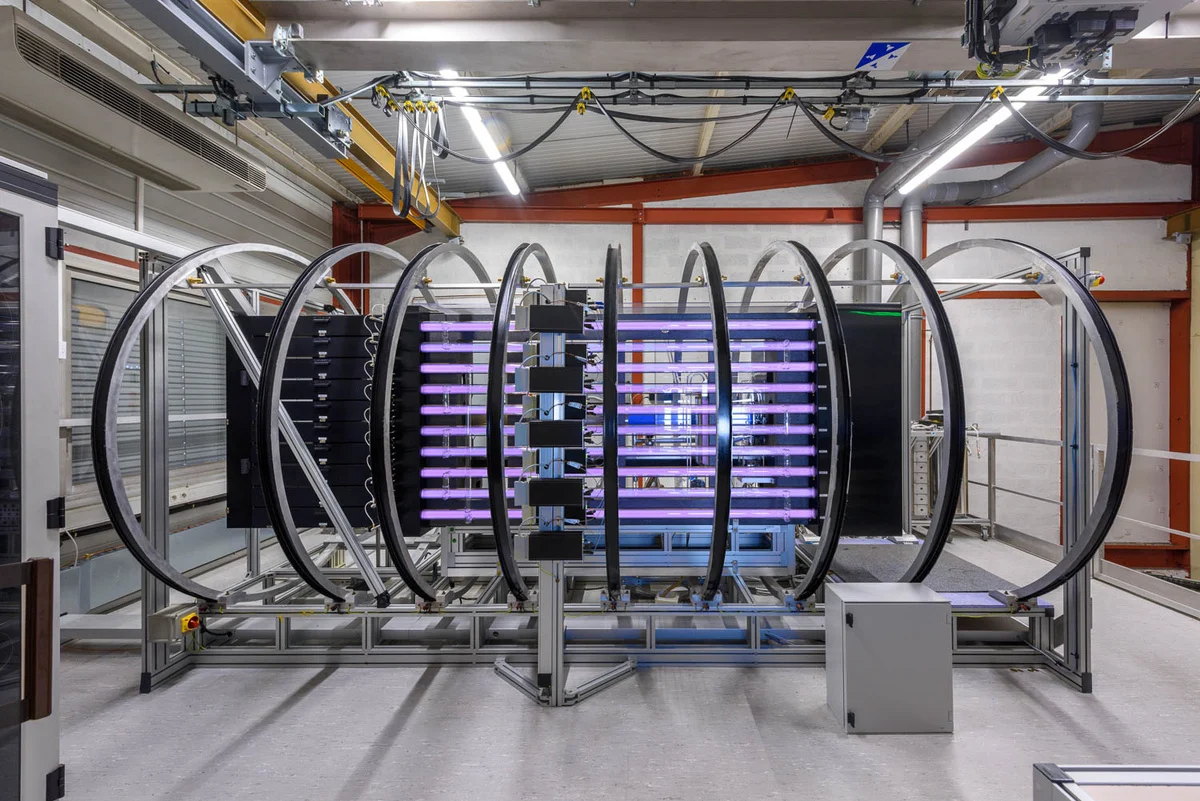
The Tyrex-2 machine designed by the ILL neutron optics department. It polarises and "recycles" helium-3.
Helium-3 under pressure
To be polarised, helium-3 must be kept at low pressure (1 mbar). Conversely, polarising a neutron beam requires the helium to be at high pressure (2 or 3 bar). Tyrex-2 solves this problem through a complex helium-3 transfer process that preserves its polarisation while compressing it to the right pressure, right up to delivery to the experiment sites.
Polarising helium-3
To avoid contaminating the gas, Tyrex-2 is equipped with multiple purification systems. A first step consists in bringing the helium contained in a tank down to a pressure of 1 mbar. This helium is injected into glass tubes subjected to an electric field and a high-power polarised infrared laser beam. Polarisation is obtained by optical pumping of an excited state of helium-3 generated by the combined action of the electric field and the laser beam. This is how the helium is polarised. This technique, called MEOP (Metastability Exchange Optical Pumping), only works at low pressure (here 1 mbar) to obtain high polarisation rates.
Preserving polarisation
The polarisation of helium-3 is a fragile state that can easily be "broken". For the helium to remain polarised, it must not be subjected to significant variations in magnetic field. Tyrex-2 is fitted with 9 coils generating an extremely homogeneous magnetic field and is built entirely from non-magnetic materials. Using a special device developed by the ILL, the polarisation of the gas is measured at this stage; it must reach a level of around 80%.
Bringing the gas up to pressure
Through a "play" of valve openings, and under the action of a 3-metre-long linear compressor driven by a hydraulic cylinder, the gas contained in the glass tubes at very low pressure is transferred, via several compression sequences, into a glass tank (a buffer). When this buffer reaches the nominal pressure of 300 mbar, the gas is transferred into the experimental cells via the same compressor. The operation is then repeated until the desired pressure is reached in the experimental cells. The gas is transferred in a single pass for small cells, and up to ten times for the largest. Filling the cells, made of glass or silicon, can take up to four hours. Tyrex-2 also processes the "dirty" helium returning from experiments via a "separate circuit" marked out by various filters.
The helium-3 polarisation and recycling installation was designed to be more autonomous than the first one. The whole point of using a solution such as Vasco was to optimise, as far as possible, the machine's various compression cycle times and to avoid losses of the precious gas.
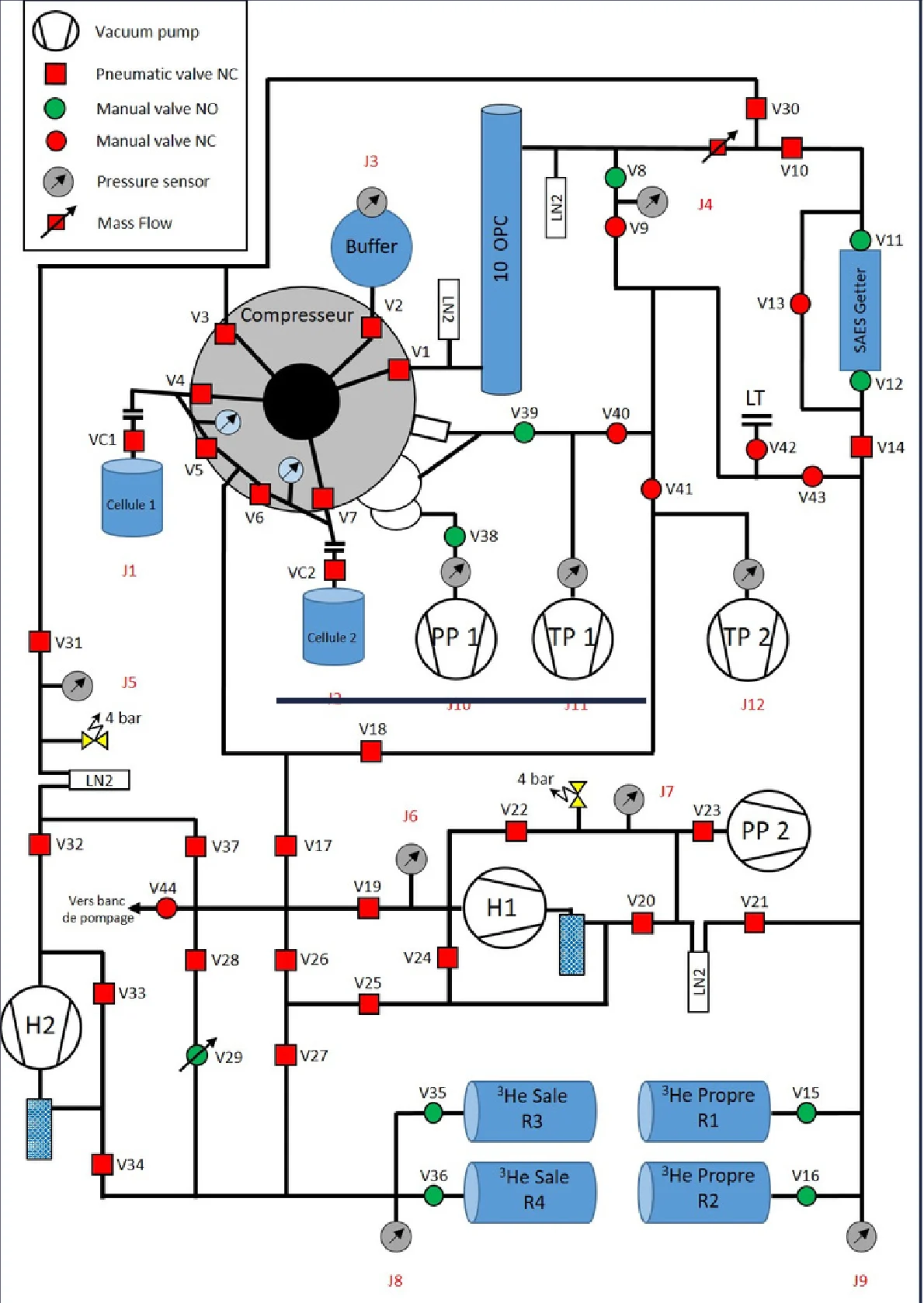
Tyrex-2 synoptic.
A successful collaboration
"Despite real in-house skills, once the machine had been built we decided to get support in choosing and implementing control software for the machine," says David Jullien.
"We issued a call for tenders. Among the solutions proposed, Nerys' stood out in several respects. The company had strong expertise in LabVIEW development. I also knew the good reputation of Mesulog, which had joined it within Nerys Group. Finally, I immediately noticed the possibilities offered by Vasco," explains David Jullien.
On the Nerys Group side, led by the duo Amaury Laurent and Benjamin Lerch, developer, there was plenty of enthusiasm for working on such a project. "The machine is magnificent and technically incredible," stresses Amaury Laurent, admiring the exceptional know-how at the ILL. "The sensor able to measure the polarisation of the helium, as well as the silicon experimental cells, among other things, were built in-house!"
"Technically, this type of project inevitably makes you progress," acknowledges Amaury Laurent.
He adds: "We encountered significant issues linked to the complexity of the machine. In particular, we had to be able to handle several actions taking place at the same time while the machine is running (simultaneous handling of two filling cells, opening and closing of valves…). We were able to provide solutions that further enrich Vasco, such as a mechanism for executing instructions remotely and exclusion locks that prevent unwanted states when two identical scenarios run simultaneously."
"The exchanges with David Jullien were very constructive. He has extremely detailed knowledge of the machine and had a very precise idea of what he wanted. He provided us with functional flowcharts, as well as mathematical formulas to work out trigger thresholds, setpoint pressure calculations, etc., which we integrated directly into Vasco," explains Amaury Laurent.
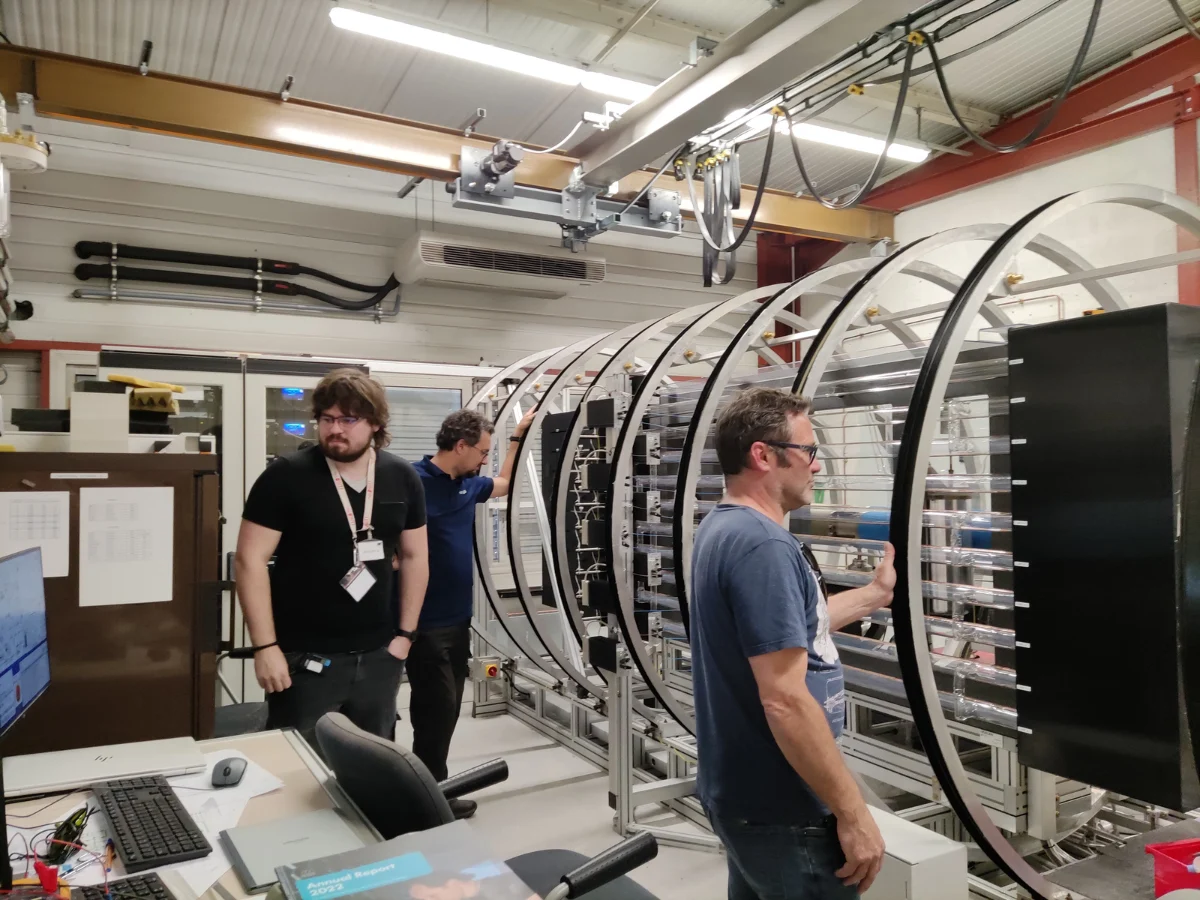
From the foreground, David Jullien, Benjamin Lerch and Amaury Laurent in front of Tyrex-2.
As for the acquisition hardware associated with the machine, the following organisation was set up:
- A Windows PC runs Vasco and displays the control interface.
- A CompactRIO runs Vasco RT (real-time). It handles the general control of the machine, the valves and the lasers. It also acquires the pressures. It also includes a distance counter and an hour counter for the cylinder.
- A CompactDAQ, located remotely by the glass tubes, collects other measurements, in particular electric fields and those related to polarisation.
The two measurement devices are synchronised using TSN (Time-Sensitive Networking).
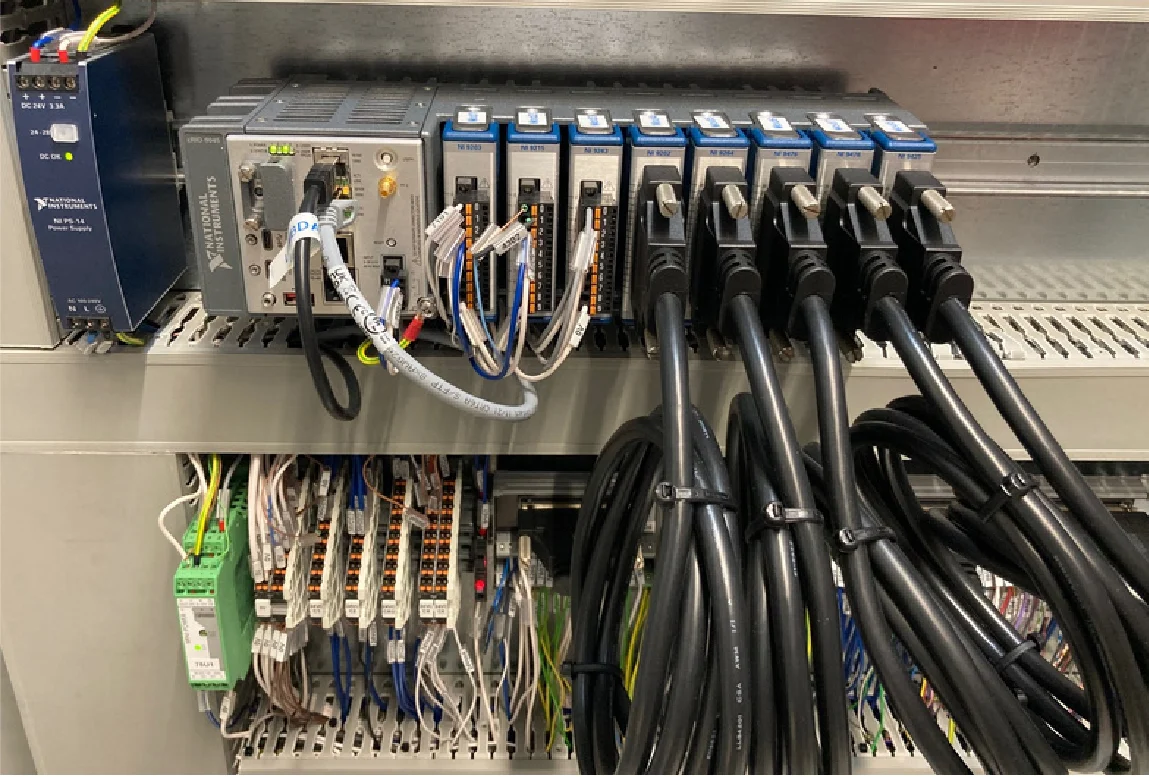
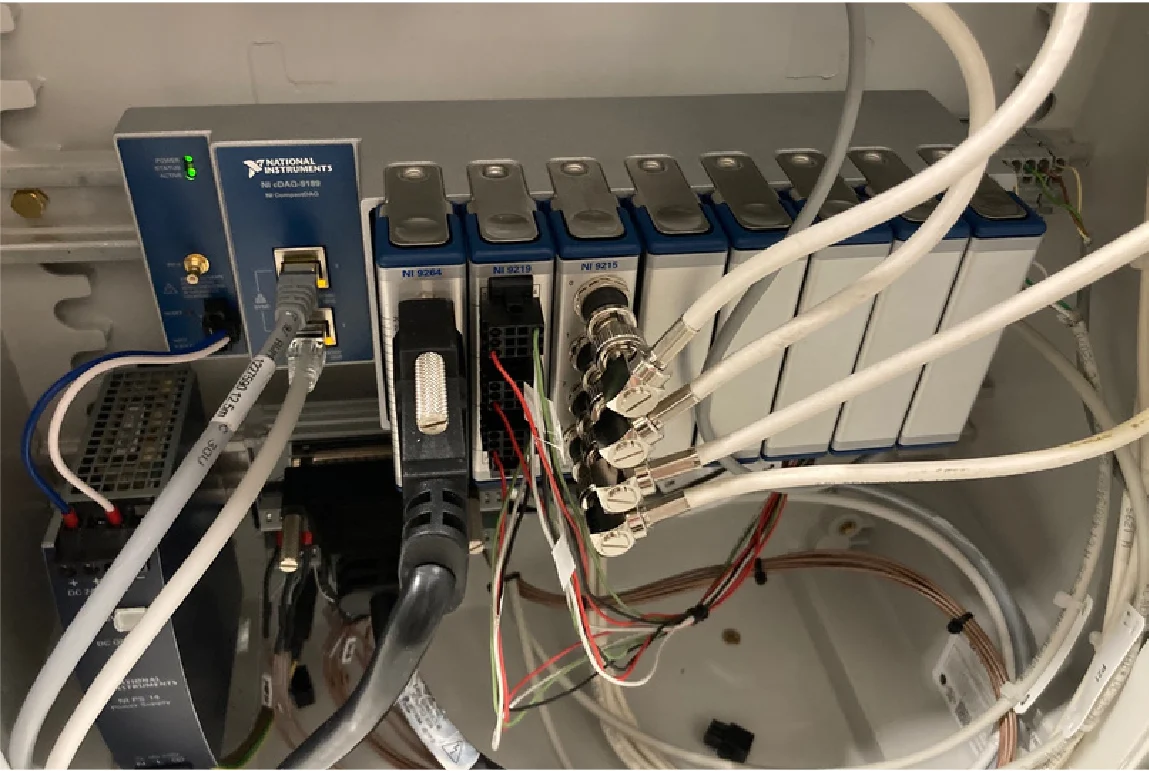
NI (Emerson) CompactRIO (photo 1) and CompactDAQ (photo 2) acquisition hardware used on Tyrex-2.
The two developers also highlight the strong added value brought to the scenarios. Nearly 2,700 lines of application scenarios were generated using Vasco's Blockscript module!
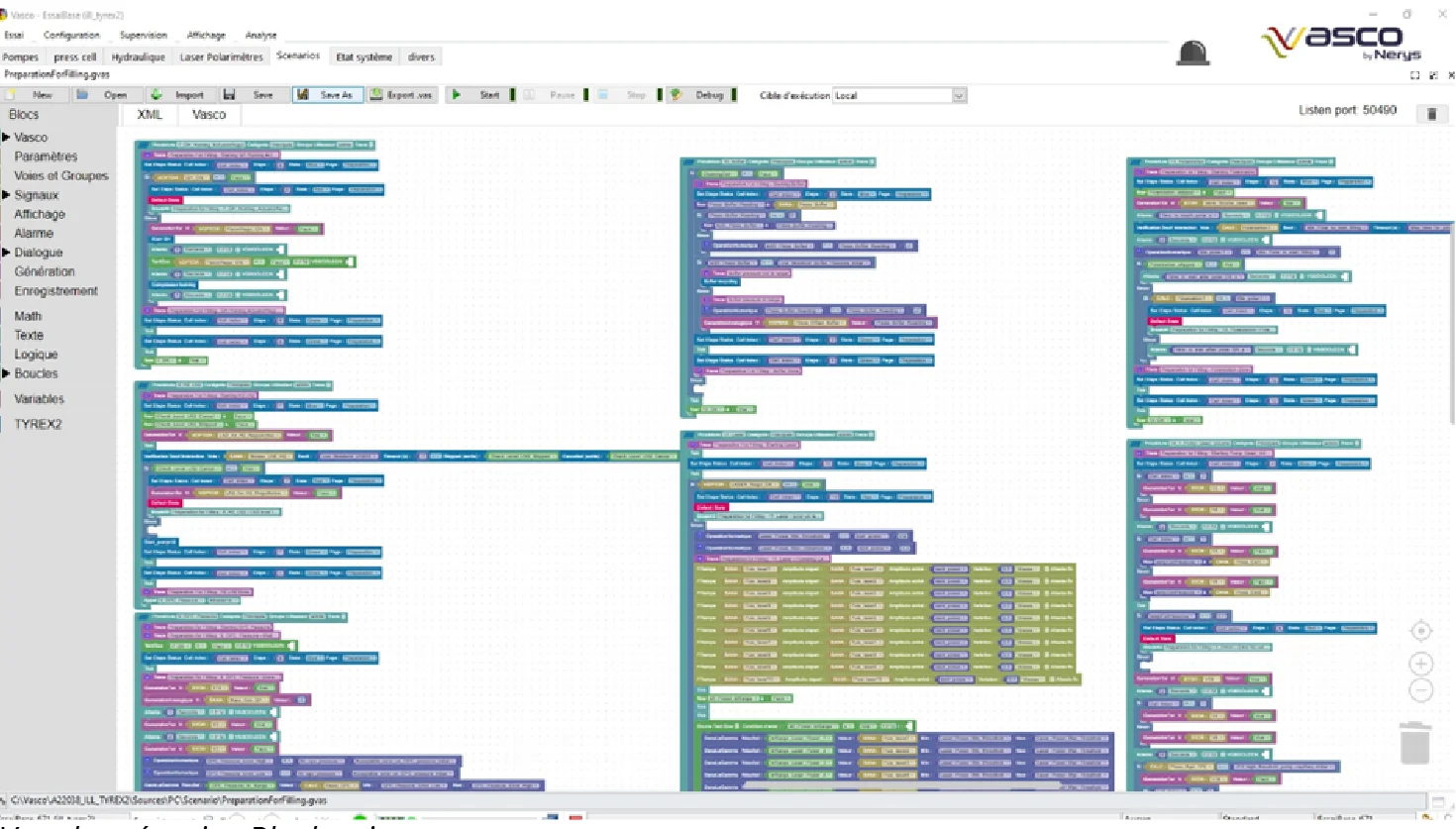
View of Blockscript scenarios.
Finally, they are also particularly proud of the look of the Tyrex-2 display and control interface, which is ergonomic, attractive and practical all at once.
The interface shows the state of the machine in real time. The main dashboard displays two filling stations (two cells) fed by a database listing all the cells in the machine's stock. This database holds nearly 400 application parameters such as valve opening trigger thresholds, pressure setpoints, travel speed, calculation constants…
Specific interfaces were developed, in particular one for displaying and controlling the optical section, and another for supervising the hydraulic unit. A display also offers a realistic visualisation of the filling of the glass tubes.
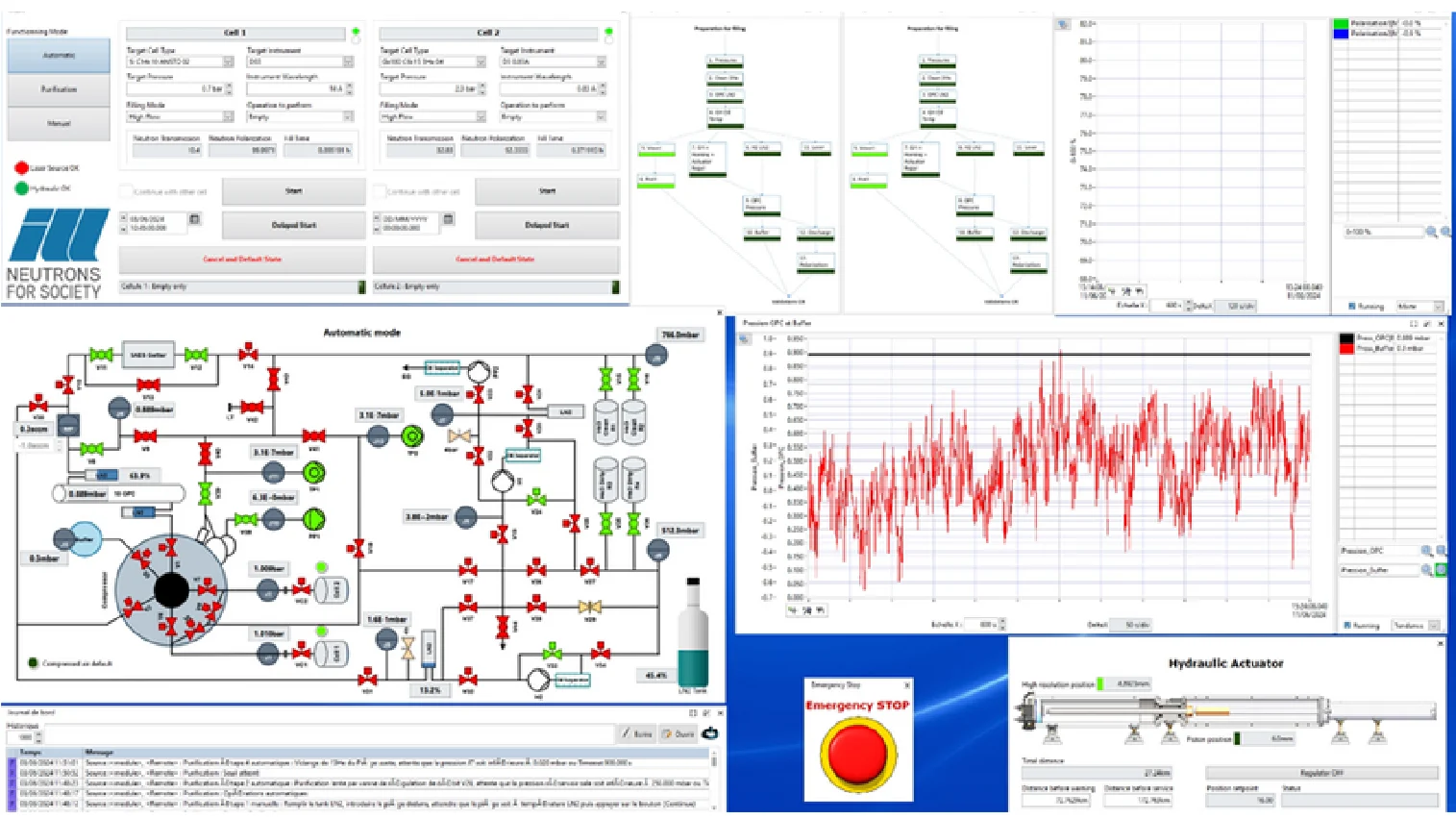
View of the Tyrex-2 machine interfaces.
"We worked closely with David Jullien. He produced some of the visuals directly in LabVIEW and we integrated them into Vasco. The result is really very nice," says Amaury.
David Jullien is also delighted with the quality of the collaboration with Nerys. "Amaury, who was my contact throughout the project, has a very good understanding of things. He is very versatile, which is invaluable for understanding the workings and subtleties of a machine like Tyrex-2. He and Benjamin were responsive and very available, enabling us to complete the machine within the expected timeframe," stresses David Jullien. "Vasco also lived up to all its promises. I particularly appreciated programming scenarios with Blockscript, which saved me an enormous amount of time while commissioning the machine," he adds.
Most of the developments carried out for Tyrex-2 required no specific code, which shows that Vasco is a highly adaptable solution. Above all, although it was designed to supervise test benches, Vasco demonstrates its ability to control complex special machines. A machine similar to Tyrex-2 has been ordered by a Swedish centre that will also produce neutron beams. Vasco will be installed on this machine. What better recognition?
To learn more about Vasco: the VascoSuite page.
Interviews conducted and written by Khady Bathily.
Thanks to David Jullien and Amaury Laurent for their testimonials.
Photo credits: ILL - All rights reserved.
Download the newsletter as a PDF (in French)


