Nerys launches version 4 of its flagship Vasco software

Nerys, which specialises in the design and construction of test installations for industry, has just released a new version of its Vasco software suite. Almost 10 years have passed between the launch of the first version of the software and this version 4.0. Caroline Couvert, chairwoman of Nerys, explains the genesis and strengths of this product.

Isn't publishing software an oddity, an anomaly among Nerys' activities?

On the contrary, it was obvious to us. The Nerys team has included software developers since its beginnings. It remains a key skill today, which we mobilise for a great many projects. When people talk about test installations, they picture equipment, machines, measuring instruments… They forget that intelligence is needed to drive and coordinate all that. That is the role of the test software. It controls an installation, programs test sequences, records data… It is, in a way, the conductor of the installation. Having reliable, adaptable software that we master is therefore a real asset for a company like ours. 

In what context did you decide to develop Vasco?

Originally, we developed Vasco to save time during the development phases of our customer applications. We succeeded by building a tool that natively integrates the functions expected in most of our customers' and partners' specifications, such as data acquisition and generation, calculation, recording and monitoring. This approach allowed us to become more competitive and to focus our skills on meeting our partners' specific needs.

And how did you move from an internal working tool to a standard product for your customers?

As we grew, we improved and simplified the structure of Vasco so that it could be used by all our developers. In particular, we adopted object-oriented programming.
Once the software was well structured and had demonstrated a certain efficiency internally, the idea of making it a product to let our customers configure and run their tests simply became obvious. We even created variants: Vascolite, which simply performs data acquisition, and Vascobox, an all-terrain test case.

What are Vasco's main strengths?

First of all, its longevity! Many companies can write code to program tests, but developing an entire system that is stable over time is an achievement we can be proud of. It takes solid skills and also a good understanding of our customers' test environments.
Then I would say adaptability.

Vasco was designed to optimise test and control procedures and is aimed at the various players in the testing chain: test engineers, thanks to its simplified configuration; metrologists, with its advanced calibration functions. It allows operators to manage a fleet of test benches more easily. They move very easily from one installation to another thanks to the same configuration and monitoring logic. It also allows developers to build their own applications.

It is a modular tool, which means it can be upgraded over time without touching the software core. This "flexibility", combined with its robustness, has made Vasco a solution acclaimed by companies in particularly demanding sectors such as automotive, aerospace, nuclear, defence and medical research.

Vasco also gives a new lease of life to installations whose mechanical part is in perfect condition while the control part has become obsolete, or simply transforms a test installation so that it adapts perfectly to the evolution of our customers' products. It is a real economic gain for our customers and an environmentally friendly approach.

What exactly are the advantages of this version 4.0?

In March 2020, we took advantage of the slowdown in pace and workload linked to the first lockdown to step back and initiate the evolution of Vasco. It was driven by requests from our customers, in particular NTN, Valeo and the CEA, but also by feedback from our colleagues who use Vasco every day. The team did a huge amount of work, resulting in an even more stable, scalable, open and fast solution.

On the feature side, we brought several new things. We improved the ergonomics and added, for example, the simultaneous display of physical and electrical data, a recurring request from many users of our software.

Vasco 4 also offers new recording formats and brings significant improvements in programming. Programming scenarios, simple or complex, has been simplified thanks to the Blockscript function (drag and drop). The aim was also to make the tool more open. Vasco 4 interacts with standard communication systems and makes it easier to integrate customers' specific drivers.

The calibration module has also been enriched with more advanced traceability functions.

 Vasco 4 has just been launched, but are you already thinking about the future?

Yes of course, we have a strong culture of innovation at Nerys. Our goal is to enable our customers to be ever more autonomous in the face of test procedures that tend to become more complex. We are also working on the exploitation of the data recorded and analysed by Vasco. The development of artificial intelligence in particular opens up new possibilities.
Discover Vasco (brochure in French) 

With the arrival of Bruno Hennetier, Nerys expands eastwards

Bruno Hennetier, former technical director of Studiel, joins the Nerys team. His mission will include developing the company's presence in the Var and Alpes-Maritimes departments.

Nerys builds its future sustainably in Gardanne

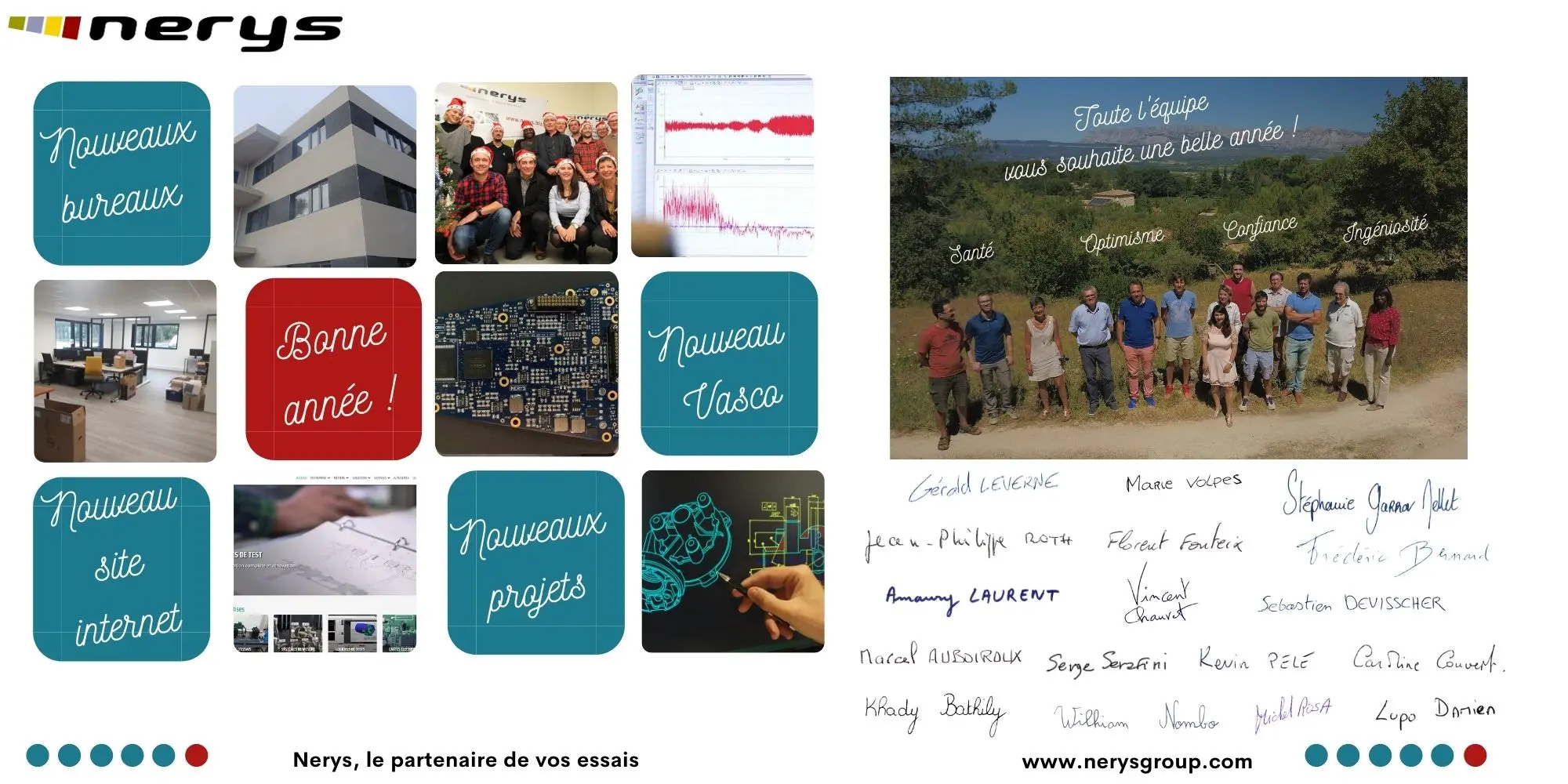
A designer of test benches and measurement systems, Nerys has acquired a new site. The 1,000 m² building, named Neorys, was built in partnership with Neowave (strong authentication solutions). It received financial support from the Aix-Marseille Provence metropolitan authority.

The first tenants of the Puits Morandat business centre in Gardanne in 2009, Nerys and Neowave confirm their pioneering spirit. They become the first companies from this business centre to build their own building at Puits Morandat. "When plots of land were put up for sale, we decided to seize the opportunity. The idea of going ahead with our neighbour from day one was obvious," say Caroline Couvert, chairwoman of Nerys, and Bruno Bernard, chairman of NEOWAVE.

Named NEORYS (for NEOWAVE and NERYS), the 1,000 m2 building is located on the western side of the Gardanne business park. In a few weeks it will be full with the arrival of My kiwi and In'Oya, two other companies currently hosted by the business centre.

The ground floor of this three-storey building, with an area of 300 m2, has housed the Nerys team since mid-December. "We wanted to start 2021 with our hands and minds free to devote ourselves fully to our customers and our assignments," explains Caroline Couvert.

Since its creation in 2007, Nerys has distinguished itself in the test and measurement sector, little known to the general public but essential for many strategic industries such as aerospace, automotive and nuclear.

"We design tools and installations that allow our customers to carry out their tests autonomously," says Caroline Couvert.

"To test a product, you have to put it in its environment, repeatedly. There it is subjected to stresses. These may be vibrations, extreme temperatures, pressures, friction… You also need instruments to measure how it reacts. Finally, you need intelligence to store and analyse the measurements taken and also to control the whole installation. We design all or part of these test systems."

"With Neorys, we give ourselves the opportunity to keep growing," she adds. The 100 m2 workshop will accommodate larger projects for our customers: Airbus, Airbus Helicopters, Ariane Group, MBDA, Schneider Electric, Technicatome, AIA, Valeo, Hutchinson…

Over the past two years, the 16-strong SME has strengthened its support functions: sales, administration and communication. It has recruited in its technical professions: software, electronics and mechanics. Resources and investments that have accelerated its skills development in embedded measurement, with the development of electromagnetic sensors and the design of electronic boards intended to operate in harsh environments.

Every year Nerys devotes nearly 15% of its revenue to R&D. It also invests in improving its products. Version 4 of its Vasco test management software will be released in spring 2021.

Although it opened a branch in Rhône-Alpes in 2018, Nerys remains deeply attached to Gardanne and the region. "We grew up here! Our employees live here or in the neighbouring towns. It is a region with a future, geographically very well placed and now well served. The forthcoming arrival of new companies at Puits Yvon Morandat and the proximity of the École des Mines de Saint-Étienne in Gardanne are real assets for our future," concludes the managing director.

Meet Kevin, one of our developers and trainers

The beginnings

At 29, Kevin PELÉ has spent most of his young career at Nerys in the software solutions development department. "After obtaining my master's degree in telecommunications electronics, I was recruited by a company based in Pau as a LabVIEW developer. It was a great experience, but probably too complex for the young graduate I was.

"At Nerys, which I joined in autumn 2017, I was given the opportunity to build up my skills gradually, in software development but not only…" he explains.

Since September, this native of Haute-Savoie has added a new string to his bow. He runs training courses for employees who want to learn the LabVIEW programming language.

"I use LabVIEW every day and it is very rewarding to be able to pass on this know-how in training courses. Despite the stress and hesitations at the start, it was a great first experience. The session was interactive, with very willing trainees. I was able to bring an operational dimension to the lessons with practical cases. We did acquisition and recording with the trainees' real work situations," he stresses.

His assignments

Within the software solutions development department, Kevin works in particular on the design of human-machine interfaces (HMI). "My role is to find tools so that the environment of the software and applications we develop for customers is pleasant, ergonomic and intuitive," he explains.

"I also work downstream of the delivery of our software solutions, with a support service for customers who encounter usage difficulties or software bugs," he adds.

Soon he will lead his first assignment as project manager: "It will involve integrating our Vasco test management software into one of our customers' applications," he says proudly.

"All this is possible thanks to the solidarity of the team members on projects. Faced with a difficulty, there is always someone to help," he is keen to point out.

A passionate runner

Progress and competition are important drivers for the young software engineer, who is a keen runner. "It's a family tradition I share with my brothers, my father and, more recently, members of the Nerys team, in particular Gérald*, who is a seasoned athlete.

"I run at least five times a week and take part in competitions." This year he trained to run the Aix 20 km in 1h30. Due to the health crisis, the event was cancelled. Kevin nevertheless wanted to take on his goals. He ran his half-marathon in 1h33.

When he isn't escaping by running, Kevin does so through reading, another family legacy passed on by his mother. "I particularly like thrillers and popular science books," he says.

*Gérald is also part of the software solutions development team. He practises triathlon, among other sports.

Want LabVIEW training? Contact us!

Our training courses are delivered by our development team of 6 developers.

  • 2 CLED-certified developers (Certified LabVIEW Embedded Systems Developer)
  • 1 CLA-certified LabVIEW architect (Certified LabVIEW Architect)
  • 2 CLD-certified developers (Certified LabVIEW Developer)
  • 1 CLAD-certified developer (Certified LabVIEW Associate Developer)

They offer various LabVIEW courses depending on your level and professional context (LabVIEW for Windows, LabVIEW Real-Time or LabVIEW FPGA).

Our courses are mainly delivered by our engineer Frédéric Bernard, who has been running LabVIEW courses for almost 20 years. He holds the highest level of LabVIEW certification: the CLA (Certified LabVIEW Architect). He also holds the CLED (Certified LabVIEW Embedded Systems Developer) certification.

Passionate about his profession, he offers lively, practical courses that will enable you to take control of and drive your LabVIEW tools on a daily basis.

Our courses take place on our premises in Gardanne (South of France), in Auvergne-Rhône-Alpes, or on your premises.
We also offer online courses.

See our training calendar.

Nerys' development team grows

The software development department at Nerys can count on a new recruit, Wilhiam Nombo, a work-study student in the first year of the MIAGE Master's programme (IT methods applied to business management) in Aix-en-Provence. Wilhiam will spend two and a half days in training and three days in the company, mostly working remotely for the time being.

The future IT specialist will mainly work on Nerys' test management software, Vasco. "For now, I'm getting to know Vasco: its structure, its features…" explains Wilhiam.

"Welcoming and training young people is one of Nerys' 'traditions'," says Caroline Couvert, chairwoman of Nerys. "Until now, we have often done so by recruiting profiles straight out of training."

She adds: "This time, we decided to go for a work-study programme. It is a partnership for the student, who is immersed in the business world. An SME is a very formative environment. For us it is also very interesting to welcome a new resource with their skills, ideas and vision. The technological environment is changing very fast. Students are on the front line to discover and take on the new challenges. Training also means preparing the next generation and the future of Nerys!" concludes Caroline Couvert enthusiastically.

Welcome Wilhiam!

The KEOPS tool for testing electrical harnesses

On helicopters intended for multi-purpose missions, electrical harnesses are fitted in anticipation of connecting the aircraft to optional equipment such as hoists, winches… To check that they work, the equipment itself was needed.

A simplified procedure for testing electrical harnesses

In 2013, Airbus Helicopters asked Avielec, an aeronautical wiring expert, to develop a simplified procedure for testing electrical harnesses. The company proposed that Nerys co-build a solution. The solution, named KEOPS for Kit & Options, consisted in developing a test machine to simulate the electrical responses of a hoist.

"We had many discussions with the helicopter operators and technicians to clarify their needs and understand the requirements of the test and quality-control procedures on the aircraft," explains Sébastien Devisscher, who led the project at Nerys. "Avielec did all the wiring of the test cabinet," he adds. Nerys took charge of the software part.

The system developed relies on a switching matrix driven by a complete program specifically developed in LabVIEW. "The switching matrix is like a grid. It makes it possible to take into account every combination of wires, test each termination and automate the setpoints," explains the project manager.

More than a thousand automated tests

The Keops interface looks like an operating procedure. Care was taken over ergonomics. "In practice, the technician, equipped with a tablet, is guided step by step throughout the procedure. Keops lets them go through the whole checklist simply and quickly. We automated a thousand electrical connection tests, which is a considerable time saving for the technicians," stresses Sébastien Devisscher.

The solution was very well received by the operational teams and the quality department of Airbus Helicopters. He adds: "From the outset, we wanted to put in place a solution that could be flexible and scalable. In this respect, we anticipated the possibility of also taking voltage and resistance measurements, etc."

A Keops 2 was built to test the connection of a sonar. A third version made it possible to check the wiring of the engines before installation. "With this development, we achieved a mature version of KEOPS. The system can now simulate all the equipment intended to be connected to electrical harnesses without any hardware development," explains Sébastien Devisscher.

Another source of pride: the system has been adopted by the German teams, where it has been running for more than two years.

Pays d'Aix video

  1480 Avenue d'Arménie
Pôle d'Activités Yvon Morandat
13120 Gardanne

  ZA du Héron
597  route des Bons Prés
73110 La Croix-de-la-Rochette

Conception de moyen d'essais

Your tests partner

Mesulog